When you study music at university it is required that you take lessons for your main instrument. Similarly, when you study music composition you have to take composition lessons. I started taking composition lessons in grad school but it was very different than instrument lessons. In my experience, the teacher was there to guide rather than a director. When I took classical guitar lessons as an undergraduate my teacher emphasized learning a lot of music from many time periods–this often ends up being a requirement for your junior and/or senior recitals. I would have to learn music that he recommend, mostly (until I started researching a bunch of stuff on my own).
In contrast, composition lessons consisted of, “what did you write this week?” “That’s great but you might consider resolving this section like this…” Or “the clarinet is really squeaky in that register…” Or “Your ending will sound much fuller if you layer the instruments like this…” Or “You’re curious about the organ? I can show you everything you need to know!” It was mostly feedback on what I was writing. No criticism just suggestions and feedback. It was great! I was in grad school for two and half years and had three teachers. All were great and helped in different ways.
One of them realized I had a curious musical nature and offered to take me to his church to learn about how the organ works. He was a great player and always had positive things to say about everything. With his assistance, I was inspired to write three pieces for organ but only one is finished and polished (the other two were okay ideas but not good enough to follow through–maybe some day I will revisit them and make it a proper trilogy). He played it for me one day and it was super fun to hear with a real organ.
I didn’t write organ music because I particularly like organ music. Quite the opposite. I find most organ music very difficult to listen to. Organ music does not have a sound decay when you strike a note (like almost every other instrument). It is always on or always off and that doesn’t sit well with me as a listener or player most of the time.
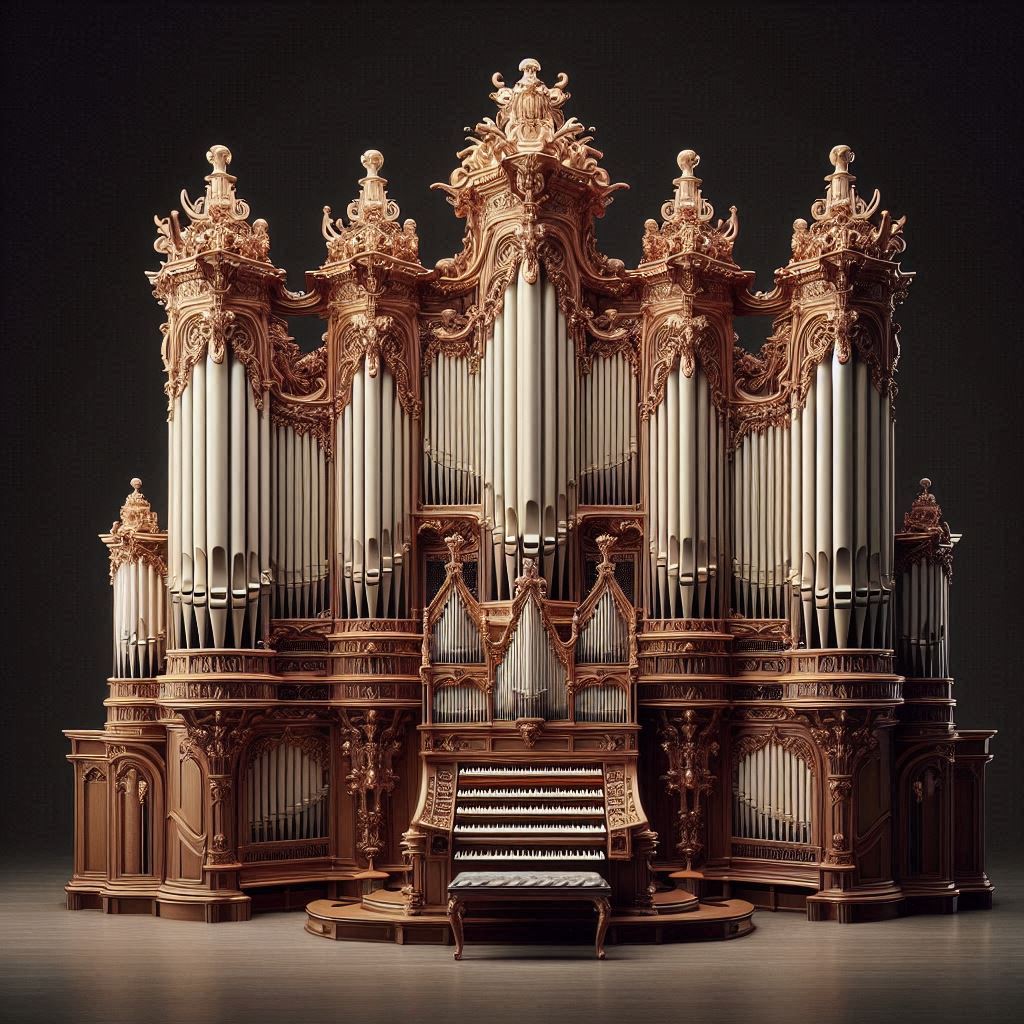
In case you don’t know, history has proven that organ music goes back to times Before Common Era (BCE). Originally there was a bellows for air to pass through tubes that were measured and cut to create specific pitches. With early versions it was someone’s job to keep the bellows pumping so the organist could play. The pipes were sometimes out in proud display and sometimes concealed in the walls of the building, almost always a church, historically. As time went on they created machines to assist with air flow. Many today use electronics.
You might notice that there are often three or four keyboards and a set of pedals. This doesn’t give you a wider note range but rather a wider palette of different sounds, timbres or color. There are pipes for every note and their purpose is to mimic the different choirs of the orchestra. There are woodwind sounding pipes, brass sounding pipes, and string sounding pipes. There is also a panel of knobs where you can select which groups of pipes you want to use. Remember that I mentioned that the sound is either on or off–that means there are no dynamics–however, you can make it seem louder by pulling out more knobs. The knobs ‘stop’ the air from travelling through the pipes so they are, not surprisingly called, ‘stops.’ This is where the phrase “pulling out all the stops” comes from. If you want the biggest sound an organ can make, you pull out all the stops.
I think one of the main problems I have with organ music is that since there are only illusions of dynamics it is difficult to separate the different melodic lines when the voices are close together, at least for my ears. It’s great if you love giant chords!
Part of my challenge when writing this piece was to make an organ composition that I can stand behind and really like. I was very successful in that. Probably too much so because after revisiting this piece I have decided to steal it for some other project. I haven’t decided if it will fit into another project I’ve started or if needs to be a small ensemble piece or maybe a nice feature in my second symphony, It’s good as an organ piece but it will great as an orchestral piece. 😄
 In the Key of K
Leave a comment